
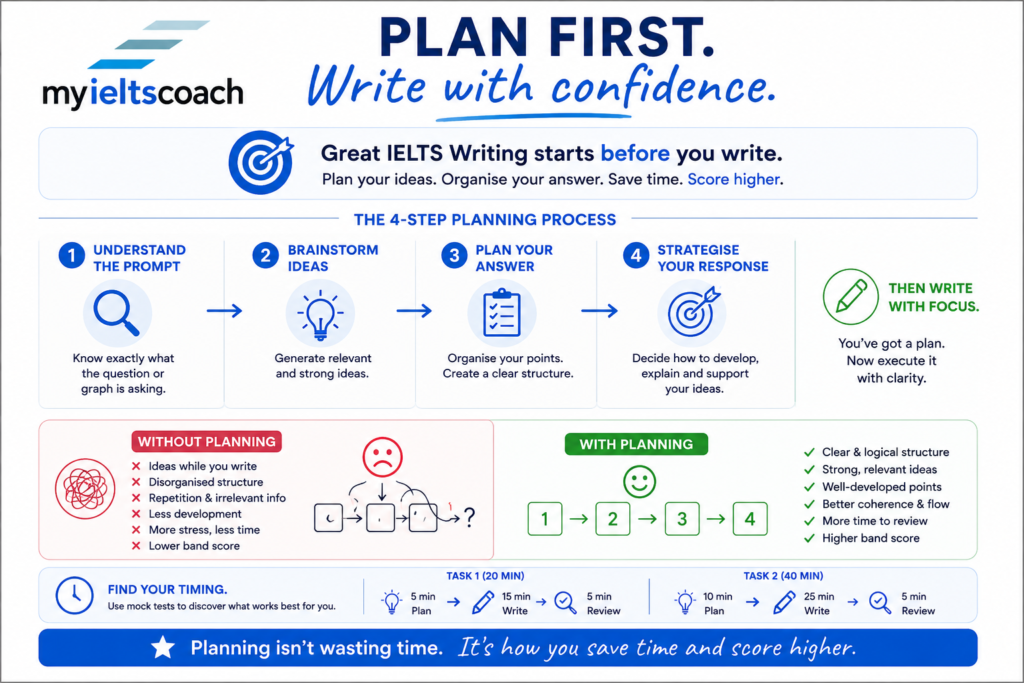
IELTS Writing: Why You Shouldn't Start Writing Too Soon
One of the biggest mistakes IELTS candidates make is starting to write before they’ve properly understood the question and planned their answer.
If you’re aiming for Band 7 or higher, give yourself time to think before you write. A few minutes of planning can help you organise your ideas, develop stronger arguments and make better use of your time.
The principle applies to both IELTS Academic and General Training.
1. Understand the task
Before you start writing, make sure you understand exactly what the question requires.
For Academic Writing Task 1:
- What does the graph, chart, table or diagram show?
- What are the main features, trends or comparisons?
- Which information is most important to include?
For General Training Writing Task 1:
- Who are you writing to?
- What is the purpose of the letter?
- What information must you include?
- What tone is appropriate: formal, semi-formal or informal?
For Writing Task 2:
- What exactly is the question asking?
- What type of question is it?
- What is your position or overall argument?
- Which main ideas will you use to support your position?
Taking a moment to understand the task helps you avoid going off-topic or missing important information.
2. Brainstorm and plan your answer
Once you understand the task, decide how you will answer it effectively.
For Task 1, identify the key features or information worth reporting. For Academic Task 1, this means selecting the most significant data and comparisons. For General Training Task 1, it means deciding how to address each bullet point clearly and appropriately.
For Task 2, establish your position and develop relevant ideas. Think about how you will explain and support each point, using examples, reasons or consequences where appropriate.
Many candidates don’t plan adequately. Instead, they try to come up with ideas while writing. This increases mental pressure and can lead to weaker arguments, repetition and poor organisation.
Your plan doesn’t need to be complicated. It simply needs to give you a clear direction before you begin writing.
3. Manage your time strategically
You have 60 minutes to complete both IELTS Writing tasks. A useful starting point is to spend approximately 20 minutes on Task 1 and 40 minutes on Task 2.
Try this timing structure:
| Task | Plan | Write | Proofread | Total |
|---|---|---|---|---|
| Academic or General Training Task 1 | 3 min | 15 min | 2 min | 20 min |
| Task 2 | 10 min | 25 min | 5 min | 40 min |
These timings are a starting point, not a strict rule. Your ideal balance will depend on how quickly you generate ideas, organise your response and write accurately.
Use timed practice tests to discover how much planning time you need to produce a strong answer without rushing the writing itself.
4. Use your proofreading time wisely
Don’t finish writing and immediately move on. Even a couple of minutes can help you identify mistakes.
Check for:
- Grammar: Are your sentences grammatically correct?
- Vocabulary: Have you used words accurately and avoided unnecessary repetition?
- Spelling: Have you spotted any obvious spelling mistakes?
- Clarity: Does your answer make sense, and are your ideas easy to follow?
- Task response: Have you answered every part of the question?
Avoid trying to rewrite entire paragraphs at the last minute. Focus on correcting clear mistakes and improving anything that could affect your score.
5. Practise planning before every answer
The best way to improve your planning is to practise it consistently.
For your next IELTS Writing practice session:
- Read the question carefully.
- Identify exactly what you need to do.
- Spend your allocated planning time brainstorming and organising your ideas.
- Write your answer using your plan.
- Proofread your response and reflect on what you could improve.
Over time, you’ll become more confident at generating relevant ideas and structuring your answers under exam conditions.
Think first. Plan strategically. Then write.
Need to improve your IELTS Writing score?
If you’re struggling to organise your ideas, answer the question effectively or reach your target band score, personalised IELTS Writing coaching can help you identify what’s holding you back and develop a more effective approach.
Start with a free IELTS assessment to discuss your target score, identify areas for improvement and explore your next steps. There’s no obligation to continue.
